The Power of Backing Your Rival
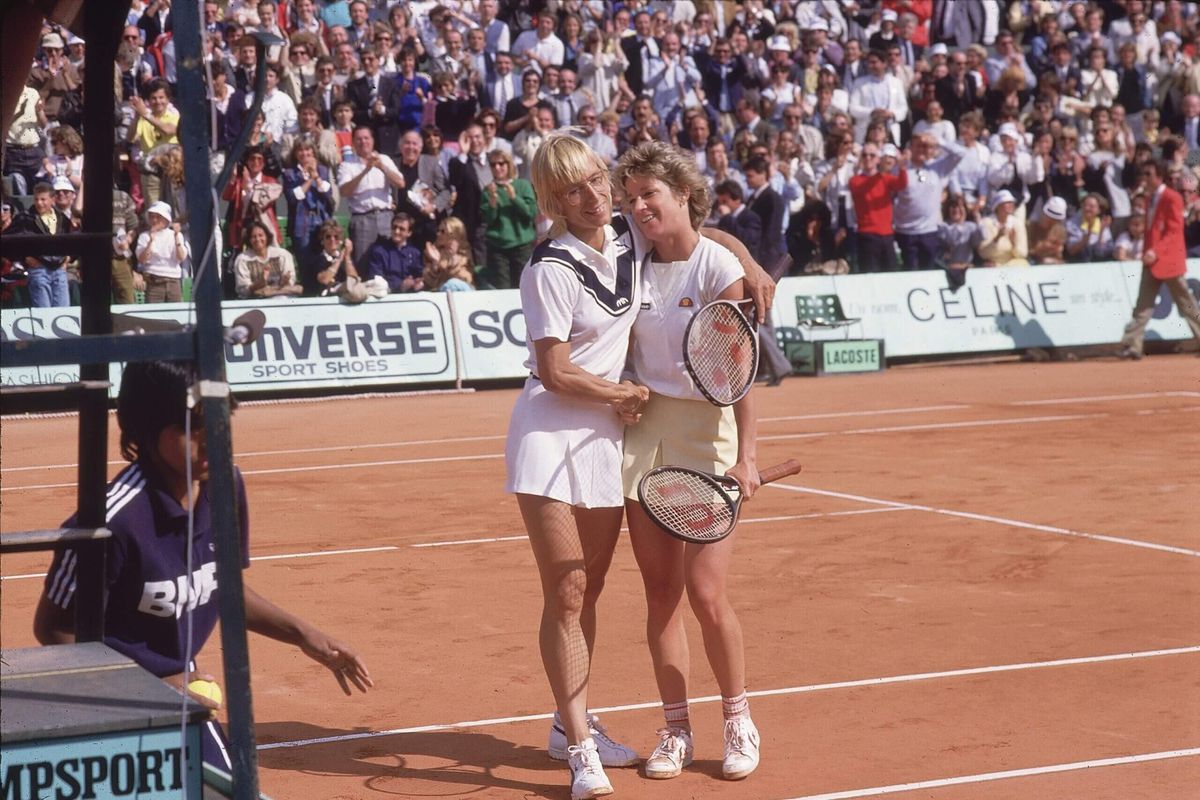
What Navratilova and Evert Taught the World
When Martina Navratilova arrived in the United States from communist Czechoslovakia in 1973, she was sixteen years old and wide-eyed about America. Chris Evert was nineteen, already a Grand Slam debutant, and widely regarded as the world's best young player. Navratilova later recalled the moment Evert acknowledged her: "She said hi to me, and I was so happy. I just wanted her to remember my name”.
That early warmth did not prevent what became one of sport's most intense rivalries. Over the following two decades, the pair met in 80 matches, including 60 tournament finals. Both finished their careers with 18 Grand Slam titles apiece. The numbers alone suggest a rivalry of extraordinary parity, two players who pushed each other to the absolute limits of human performance.
Yet something else was happening beneath the surface. For years, Evert maintained what she herself described as a professional wall. "I was No. 1, and she was up-and-coming”, she has said. "She knew my game better than anyone and knew me emotionally and mentally. My priority was to be No. 1". It was a rational, if cold, calculus. In an individual sport where a single opponent can undo years of effort, treating your greatest rival as a friend felt like a liability.
But somewhere in the late 1980s, the calculation shifted. "We'd be the only ones left in the locker room every Sunday after the finals, Evert recalled, and it hit me. Finally, I could separate competing and having a good friend”.
What followed was a friendship that deepened with age and was ultimately tested by something far harder than any tennis match. When Evert was diagnosed with ovarian cancer in 2021 and Navratilova was diagnosed with throat and breast cancer in 2022, each became the other's most steadfast support. Evert sent texts and called whenever Navratilova felt at her lowest. "It wasn't something we needed to get closer to each other”, Navratilova has said, "but knowing the other one's there and knows what you feel like, it's like you're not alone anymore”.
They didn't win those battles because they were rivals. They won them because they had learned, across fifty years, that backing each other was always the stronger move.
What Federer and Nadal Showed Us About Respect
Roger Federer and Rafael Nadal met on a tennis court 40 times. Nadal leads the head-to-head 24 wins to 16, including a 10-4 advantage in Grand Slam meetings. Their 2008 Wimbledon final played across four hours and 48 minutes, interrupted by rain, finished in near darkness, is widely regarded as the greatest match in the sport's history. Federer lost his five-year winning streak at Wimbledon that day. By any measure, these were two people separated by fierce, unrelenting competition.
And yet Toni Nadal, Rafael's uncle and long-time coach, has spoken of the relationship with something close to reverence. "They showed to the people that you can have a very intense rivalry, but at the same time to have a good respect. And you can be a friend of your opponent. Normally this doesn't happen, and with these two guys it happened and that was special”.
When Federer retired at the 2022 Laver Cup in London, he chose to play his final match alongside Nadal, his greatest rival, now his doubles partner. After the match, both men wept openly. "When Roger leaves the Tour," Nadal said, an important part of my life is leaving too, because all the moments that he has been next to or in front of me are important moments of my life”. And Nadal, upon hearing the news of Federer's retirement, wrote publicly: "Dear Roger, my friend and rival. I wish this day would have never come”.
That sentence "my friend and rival" carries more leadership wisdom than most leadership texts or teachings.
What These Rivalries Teach Leaders
The instinct to view competition as a zero-sum game is deeply human. If my rival succeeds, the thinking goes, I must have failed. This instinct has a certain evolutionary logic. But it is a poor guide for leaders operating in complex organisations, in coalition governments, or in industries where the raising of all boats is both possible and desirable.
What Evert, Navratilova, Federer, and Nadal demonstrated is something quite different: that the presence of a worthy rival does not diminish your own achievement. It enables it. The standard you are held to rises. The effort required to remain excellent increases. And when the competition is accompanied by genuine respect, even affection, the result is a culture in which both parties perform at levels neither could have sustained alone.
The leadership lesson is not to stop competing. It is to compete with enough respect for your rival that you can recognise, acknowledge, and even champion their strengths because doing so ultimately raises the standard for everyone.
What This Means for New Zealand Politics
New Zealand heads to a general election in November 2026. The political contest between the National-led coalition government under Prime Minister Christopher Luxon and the Labour-led opposition under Chris Hipkins is, by reading the polls, tight. As the campaign intensifies, the pressure on both sides to oppose rather than agree, to score points rather than solve problems will only grow.
This is understandable. Elections are adversarial by design. But the adversarial instinct, left unchecked, produces a particular pathology: the rejection of sound policy simply because it originated on the other side of the aisle. Leaders become so invested in defeating their rival that they lose sight of what the competition was supposed to produce, better outcomes for us, the people they represent.
The tennis greats did not win by ignoring their opponents' best qualities. They studied them, acknowledged them, and adapted. There is a case to be made that New Zealand's political leaders of all stripes, would serve the country better by applying a similar discipline: backing ideas that are sound, regardless of their source, and resisting the temptation to compete for its own sake when collaboration would produce a more durable result.
This is not a call for political consensus at the expense of genuine debate. Vigorous opposition is essential to good governance. But there is a meaningful difference between opposing policy on its merits and opposing it because your opponent proposed it and New Zealand's voters are increasingly capable of telling the two apart.
The Organisational Parallel
The same question applies inside organisations, and this is where New Zealand's business leaders and managers have the most direct influence.
Consider how often internal competition between departments, teams, business units, or individuals vying for the same promotion, functions has a drag on collective performance. Sales competes with marketing. Operations compete with product. One division guards its data because sharing it might allow another to outshine it. The energy that could have been directed outward, toward customers and competitors, turns inward.
Research into high-performance teams has found that internal competition and internal collaboration are not mutually exclusive but they require careful conditions to coexist productively. Left unmanaged, internal competition tends to erode trust, fragment information flow, and create incentive structures that reward individual performance at the expense of team outcomes. The question for any leader is whether the competition they are tolerating or encouraging inside their organisation is making the whole more excellent or simply redistributing the glory.
A Call to Action for New Zealand Leaders
The leaders who endure, in sport, in politics, and in business are rarely those who competed the hardest in isolation. They are those who had the self-assurance to back their rival when their rival was right, to acknowledge strength when they encountered it, and to understand that greatness is rarely a solo performance.
Evert and Navratilova spent fifty years pushing each other toward the highest version of themselves. Federer and Nadal inspired an entire generation of players and fans not only through their brilliance, but through the grace with which they held each other in regard.
New Zealand's leaders and executives face their own version of this challenge every day. The next time a good idea comes from a rival team, a political opponent, or a competitor in your market, ask yourself the question that separates the merely competitive from the genuinely great: am I willing to back this, not because it benefits me, but because it is the right call?
That, in the end, is what leadership looks like.